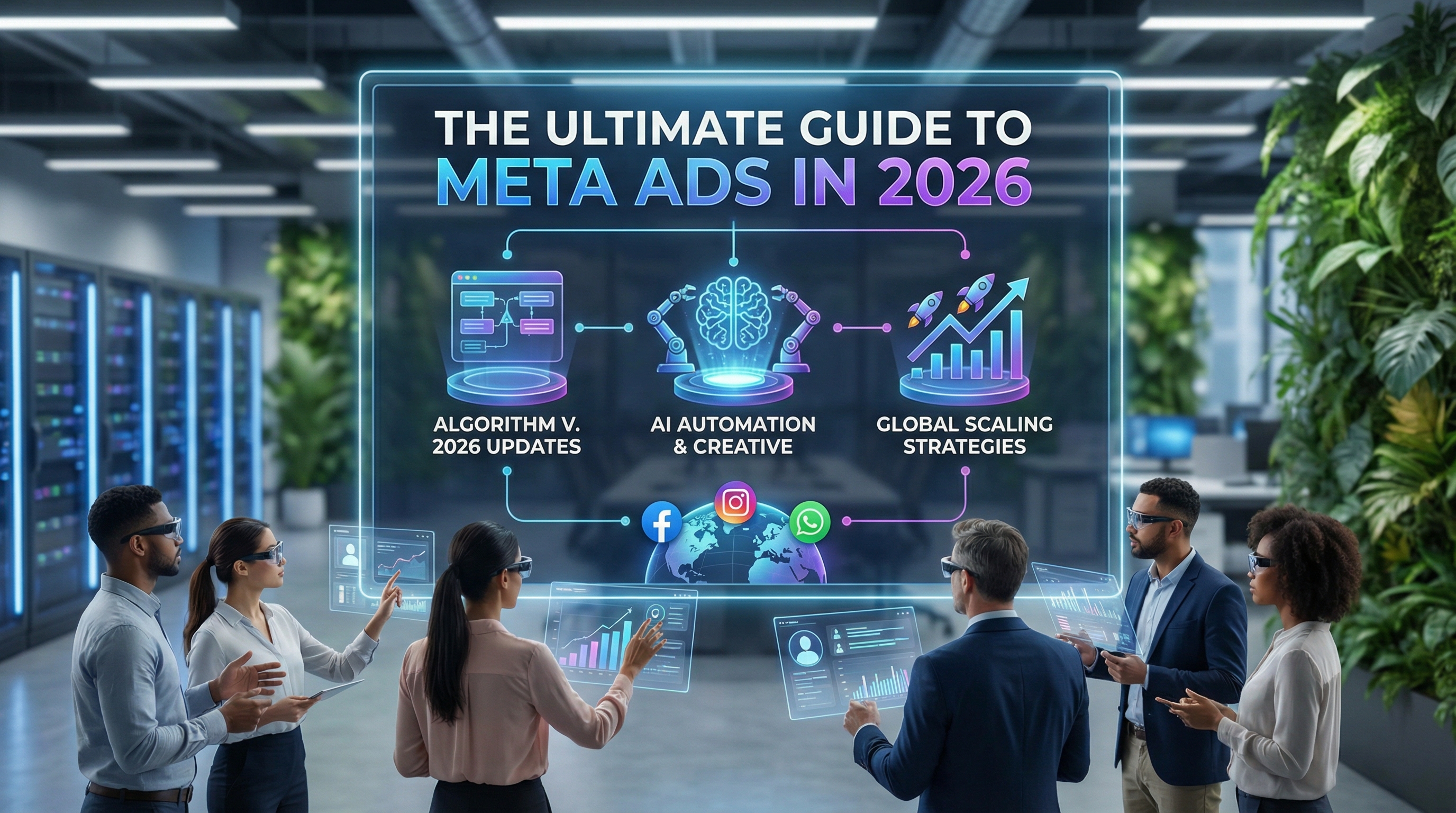
The digital advertising landscape has undergone a massive reset. If you are still running Facebook and Instagram campaigns using the 2023 or 2024 playbook, you are likely burning through your budget with little to show for it. Welcome to 2026, where artificial intelligence doesn’t just assist your campaigns; it completely runs them.
As the platform evolves, the barrier to entry has lowered, but the barrier to profitability has never been higher. Anyone can click “Boost,” but understanding the intricate mechanics of the new algorithm is what separates a casual marketer from the best meta ads expert. In this comprehensive guide, we are going to break down every recent change, algorithm update, and feature rollout on the Meta platform so you can stop guessing and start scaling.
Contents
- 1 The End of Manual Targeting and the Rise of AI
- 2 The Three Pillars of Meta Ads in 2026
- 3 The GEM Algorithm & Why “Creative is the New Targeting”
- 4 How the GEM Model Actually Works
- 5 The “Sea of Sameness” Trap
- 6 Broad Targeting is Not a Trend; It is a Requirement
- 7 Mastering Meta’s 2026 Technical Arsenal: Conversions API, Advantage+, and Flexible Creative
- 8 1. The Conversions API (CAPI): The Non-Negotiable Tracking Standard
- 9 2. Advantage+ Takes Over
- 10 3. Flexible Creative & DCO 3.0
- 11 Structuring Advantage+ Campaigns for Maximum ROI
- 12 The “Hybrid” Account Structure
- 13 A Real-World Example: Scaling High-Ticket Campaigns
- 14 Navigating the 2026 Attribution and Tracking Updates
- 15 The Shrinking Attribution Window
- 16 Event Match Quality (EMQ) is the New Gold Standard
- 17 The Shift to MER (Marketing Efficiency Ratio)
- 18 Advanced Scaling Strategies for 2026
- 19 1. The 20% Vertical Scaling Rule
- 20 2. Horizontal Scaling via Creative Diversity
- 21 3. Optimizing for MER, Not Just ROAS
- 22 Conclusion: Stop Guessing and Start Growing
The End of Manual Targeting and the Rise of AI
For years, media buyers prided themselves on their ability to uncover hidden audiences. The standard operating procedure was to stack interests, layer demographic filters, and exclude specific behaviors to find the perfect customer.
In 2026, that strategy is officially obsolete.
Meta has fully transitioned from a manual advertising platform to an AI-driven predictive ecosystem. With the full rollout of their underlying AI engine (often referred to as Andromeda), Meta now relies on machine learning to allocate your budget, decide ad placements, and find your buyers in real-time.
What Changed?
Recently, Meta retired several detailed targeting exclusions and layered filters. They have pushed advertisers heavily toward Advantage+ Campaigns, which strip away manual controls in favor of algorithmic delivery.
Instead of asking who you want to target, Meta’s system now asks what you want to achieve. It analyzes thousands of data points from a user’s scrolling speed to their cross-platform engagement to predict conversion likelihood with astonishing accuracy.
If you ask the best meta ads expert in the industry how they are finding winning audiences today, they will tell you a hard truth: they aren’t. They are letting the algorithm do it for them.
The Three Pillars of Meta Ads in 2026
To succeed in this new environment, you need to shift your mindset from being an “audience hacker” to a “data provider.” Meta’s algorithm is a powerful engine, but it needs the right fuel. In 2026, that fuel consists of three main pillars:
- Creative Signals: Your ad creative (the video, image, and copy) is your new targeting. The algorithm reads your visuals and text to determine who will engage with it.
- Unrestricted Liquidity: Giving the algorithm broad audiences and consolidated budgets so it has the freedom to find the cheapest conversions.
- Clean Data Integration: Feeding server-side tracking data (via the Conversions API) back to Meta so the AI knows exactly who is buying and who is just browsing.
If your campaigns are failing right now, it is rarely because the platform is broken. It is usually because you are trying to micromanage a system that was built to run on autopilot. Learning to let go of the steering wheel while providing the best possible map is the defining trait of the best meta ads expert.
The GEM Algorithm & Why “Creative is the New Targeting”
If you spend any time in media buying forums or talking to a top-tier agency, you will hear a lot of panic about “declining ROAS” or “unstable CPAs.” The truth is, the platform isn’t broken the rules of engagement have just fundamentally changed.
Meta recently rolled out a massive overhaul to its AI architecture, heavily relying on models known internally as Lattice, Andromeda, and the Generative Ads Recommendation Model (GEM). These aren’t just minor backend tweaks; they represent a complete paradigm shift in how ads are distributed.
If you want to position yourself as the best meta ads expert in your niche, you must understand how these systems process your campaigns.
How the GEM Model Actually Works
In the past, Meta optimized delivery based primarily on the audience parameters you manually selected (e.g., targeting people aged 25-45 who like “Yoga” and “Online Shopping”).
Today, the GEM model is built on a Large Language Model (LLM) framework similar to the technology powering ChatGPT. But instead of reading text prompts, it “reads” your ad creative.
When you upload a video or an image, Meta’s AI scans everything:
- The objects in the background of your video.
- The tone of voice and the accents of the people speaking.
- The text overlays and the pacing of the cuts.
- The underlying emotional appeal of the visuals.
The system then uses these “creative signals” to find your ideal customer. Your creative is no longer just the art; it is the targeting mechanism itself. If your ad looks like a lo-fi, authentic review from a busy mom, Meta will automatically serve it to demographics that engage with that specific style of content.
The “Sea of Sameness” Trap
Because AI tools have made it incredibly easy to churn out hundreds of ad variations, many advertisers fall into the “sea of sameness.” They generate 20 videos that all look, sound, and feel identical, simply changing the color of a button or the first three seconds of a hook.
Meta’s new Andromeda filter is designed to kill this noise. If your ads are too similar, the algorithm bundles them together, limits your reach, and spikes your costs.
To beat the algorithm, the best meta ads expert doesn’t focus on micro-tweaks. They focus on Creative Diversity. You need to feed the machine radically different concepts so it can find radically different pockets of buyers.
The 2026 Creative Starter Pack
If you are launching a new product today, your campaign shouldn’t feature five variations of the same polished graphic. Instead, a winning ad set should look something like this:
- The “Founder’s Story” (Trust Builder): A raw, selfie-style video explaining why the product exists. This appeals to emotional buyers and builds long-term brand equity.
- The “Chaotic Comparison” (Logic Appeal): A fast-paced, split-screen video showing the old, frustrating way of doing things versus your new, efficient solution.
- The “Native UGC” (Social Proof): A seemingly unpolished video of a real customer using the product in their messy kitchen. It blends perfectly into the Reels or Stories feed.
- The “Screenshot Proof” (Curiosity Hook): A simple, static image of a text message thread or a highly-rated review. It acts as a massive scroll-stopper.
By giving the system these distinct, high-contrast creative angles, you are casting a wide net. Meta’s AI will test these signals, find the exact sub-audiences that resonate with each format, and scale your budget accordingly.
Broad Targeting is Not a Trend; It is a Requirement
Because the AI is doing the heavy lifting of matching creative to consumers, restricting the algorithm with narrow interest targeting is essentially tying its hands behind its back.
This is why Advantage+ Shopping Campaigns (which we will cover in a later step) are dominating the platform. By leaving targeting completely broad only restricting by age or location you give the Lattice and GEM models the freedom to hunt for the cheapest conversions across Meta’s entire user base.
A mediocre marketer blames the algorithm for poor performance. The best meta ads expert understands that the algorithm is just a mirror; if the results are poor, it means the creative signals you are feeding it are weak.
Mastering Meta’s 2026 Technical Arsenal: Conversions API, Advantage+, and Flexible Creative
Understanding the algorithm is only half the battle; the other half is properly setting up your technical infrastructure. Meta’s AI is the smartest media buyer on the planet, but it is completely blind without accurate data.
In 2025 and moving heavily into 2026, Meta fundamentally altered its tracking and campaign structures. Third-party cookies are actively depreciating, privacy regulations are stricter than ever, and legacy tracking methods are causing massive signal loss. If your campaigns are suddenly underperforming, your technical setup is likely the culprit.
Here is a breakdown of the critical 2026 features you must implement to stay profitable.
1. The Conversions API (CAPI): The Non-Negotiable Tracking Standard
Relying solely on the traditional Meta Pixel is a guaranteed way to lose money in 2026. Because of browser restrictions and ad blockers, the Pixel alone misses a massive chunk of your conversion data.
To fix this, Meta leans heavily on the Conversions API (CAPI). Instead of tracking data through the user’s browser, CAPI establishes a direct, secure server-to-server connection between your website (or CRM) and Meta’s servers.
Why is this critical? Imagine running a lead generation campaign for a high-ticket real estate project. If your Pixel only tracks the initial form fill, Meta’s AI assumes every lead is equal. However, by using CAPI integrated with your CRM, you can send “offline conversion” data back to Meta when a specific lead actually books a site visit or signs a contract.
This teaches the algorithm what a high-quality lead looks like, rather than just a cheap click. Any best meta ads expertwill tell you that implementing “dual tracking” (running both the Pixel and CAPI simultaneously for event deduplication) is the absolute first step before launching a new campaign.
2. Advantage+ Takes Over
Meta has aggressively phased out granular manual controls in favor of its AI-driven Advantage+ suite. If you are still trying to micro-target specific interests, you are fighting a losing battle against the platform’s native architecture.
- Advantage+ Shopping Campaigns (ASC): For e-commerce, ASC is now the default. It bypasses traditional ad set structures, combining prospecting and retargeting into one fluid campaign. Meta tests up to 150 creative combinations simultaneously, automatically distributing your budget to the highest-performing segments.
- The Death of Detailed Targeting Exclusions: Meta has effectively removed the ability to exclude specific detailed interests. The system found that removing these constraints actually lowered the median cost per conversion by over 20%. The algorithm now uses your first-party data (like customer lists) as a seed, expanding outward using predictive intent modeling.
3. Flexible Creative & DCO 3.0
The days of duplicating ad sets just to test a new headline are officially over. Meta has upgraded its Dynamic Creative Optimization (DCO) into a more fluid “Flexible Creative” format.
Instead of building individual ads, you provide the system with a “pool” of assets: up to 10 images or videos, 5 primary texts, 5 headlines, and multiple Call-to-Action buttons. The Andromeda algorithm then dynamically assembles these pieces in real-time, tailoring the exact combination to the specific user and placement.
For example, the AI might know that “User A” converts best when they see a short vertical video with a long-form text caption on Instagram Reels, while “User B” converts best on a static image with a punchy, one-sentence headline on the Facebook Feed.
Operating like the best meta ads expert today means acting more like an art director than a traditional media buyer. Your job is to supply the AI with diverse, high-quality creative ingredients, and let the machine bake the cake.
Structuring Advantage+ Campaigns for Maximum ROI
If you look inside the ad account of an amateur advertiser, you will usually find chaos: 20 different campaigns, 50 fragmented ad sets, and tiny daily budgets spread so thin that the algorithm starves.
In 2026, the cardinal rule of Meta Ads is Consolidation.
Meta’s machine learning requires roughly 50 conversion events per ad set per week to officially exit the “learning phase” and stabilize performance. If your budget is chopped up into a dozen micro-targeted ad sets, you will never hit that threshold. Your ads will remain stuck in a perpetual learning phase, resulting in volatile costs and inconsistent lead flow.
To operate like the best meta ads expert, you need to build a campaign architecture that keeps Meta’s automation inside clear, strategic guardrails.
The “Hybrid” Account Structure
While Meta pushes advertisers to put 100% of their budget into Advantage+ Shopping Campaigns (ASC) or Advantage+ Lead campaigns, going fully automated right away is a mistake for most brands. Instead, the most profitable accounts are using a “Hybrid Structure.”
Here is exactly how to set it up:
1. The Advantage+ Scale Campaign (70% of Budget)
This is your powerhouse. It is a single, broad-targeted Advantage+ campaign focused purely on your primary conversion event (like “Purchase” or “Lead”).
- Targeting: Completely broad. No interest targeting. Only restrict by essential demographics (like age or location).
- Creative: Feed this campaign a high volume of your proven, winning creatives. Include 5-10 distinct concepts (a mix of Reels, statics, and carousels).
- Purpose: Let the algorithm use its vast data network to hunt for the cheapest conversions across the platform.
2. The Creative Testing Sandbox (20% of Budget)
Never test new ad concepts inside your main Scale Campaign. It disrupts the algorithm.
- Structure: Create a separate, manual campaign utilizing Campaign Budget Optimization (CBO).
- Process: Launch new video or image concepts here. Once an ad proves it can generate conversions at your target Cost Per Acquisition (CPA), you “graduate” that specific ad into your Advantage+ Scale Campaign.
3. The High-Intent Retargeting Campaign (10% of Budget)
While Advantage+ natively mixes prospecting and retargeting, it often ignores highly specific, bottom-of-funnel audiences.
- Structure: A manual campaign targeting specific custom audiences.
- Purpose: Use this to close the hottest leads.
A Real-World Example: Scaling High-Ticket Campaigns
Let’s step away from standard e-commerce for a moment and look at a complex, high-ticket industry. Imagine you are running lead generation for a commercial real estate developer selling premium office spaces or luxury villas in Chennai.
In the past, you might have created separate ad sets targeting “Real Estate Investing,” “Luxury Lifestyle,” and “Chennai Business Owners.”
In 2026, that structure will fail. Instead, you would launch a single broad Advantage+ campaign targeting the Chennai region. To find your buyers, you would rely entirely on your creative.
You would launch one video highlighting the ROI of the commercial properties (appealing to investors), a carousel showcasing the architectural design (appealing to end-users), and a founder-led video discussing the growth of the Chennai market. Meta’s algorithm will analyze those distinct creative signals and automatically find the high-net-worth individuals in the region most likely to submit a lead form.
By consolidating the budget into one campaign, the AI gets the 50 conversions it needs much faster, allowing it to optimize and stabilize the cost per lead. This is the exact playbook the best meta ads expert uses to scale spend without breaking profitability.
If you logged into your Ads Manager in mid-January 2026 and felt a sudden wave of panic because your conversions seemed to drop overnight, you are not alone. Many advertisers assumed their campaigns had completely broken.
In reality, the ads were likely performing just as well as the day before, but Meta permanently changed how it reportsthose results. Understanding these underlying tracking mechanics is essential. The best meta ads expert doesn’t just know how to launch a campaign; they know how to accurately read the data it produces without falling for platform illusions.
The Shrinking Attribution Window
In early 2026, Meta made a massive update to its Ads Insights API by removing the longer view-through attribution windows.
Previously, if someone saw your ad, didn’t click it, but then remembered your brand and bought something a week later, Meta would claim credit for that sale under a 7-day or 28-day view window. Today, Meta has significantly shrunk that view attribution down to just 1 day.
What this means for you:
- B2B and High-Ticket Lead Generation: If you are running campaigns with long sales cycles like commercial real estate investments or high-end agency services your in-platform conversion counts will look artificially low.
- Awareness Campaigns: Video views and display campaigns will show a lower direct Return on Ad Spend (ROAS) because delayed, post-view conversions are no longer being tracked natively in the dashboard.
Do not pause a winning campaign just because the Meta dashboard looks worse than it did in 2025. The platform is simply taking less credit for the halo effect of your marketing.
Event Match Quality (EMQ) is the New Gold Standard
Because browser-level tracking is becoming obsolete due to strict privacy laws and ad blockers, Meta now relies on the Conversions API (CAPI) to receive server-side data. However, just having CAPI installed is no longer enough.
In 2026, the algorithm heavily weights your Event Match Quality (EMQ) score. This score (rated from 1 to 10) indicates how confidently Meta can link a conversion on your website back to a specific Facebook or Instagram user profile.
To get a high EMQ score, you must pass robust first-party data back to Meta’s servers, including:
- Hashed email addresses
- Phone numbers
- IP addresses
- Geographic location (City/State/ZIP)
If your EMQ score sits below a 6, the algorithm struggles to understand who your buyers actually are, which sends your campaigns back into the dreaded “learning phase.”
The Shift to MER (Marketing Efficiency Ratio)
Because Meta’s native attribution is now heavily restricted, top-tier media buyers have changed how they measure success.
Instead of obsessing over the ROAS reported inside Ads Manager, you must start looking at your Marketing Efficiency Ratio (MER). MER is calculated simply by taking your Total Business Revenue and dividing it by your Total Marketing Spend across all platforms.
If you launch a new Meta Ads campaign and your Meta-reported ROAS drops, but your overall business revenue and MER go up, the campaign is working. It is likely driving highly valuable awareness that is converting through organic search or direct traffic later on.
Advanced Scaling Strategies for 2026
Once you have a campaign that is consistently generating profitable leads or sales, the hardest part begins: scaling.
Historically, scaling on Facebook and Instagram was a terrifying process. You would increase your daily budget, and immediately, your Cost Per Acquisition (CPA) would skyrocket. In 2026, Meta’s AI is much more stable at higher spends, but you still need a disciplined approach to avoid throwing your ad sets back into the dreaded “learning phase.”
Here is how the best meta ads expert scales a winning account today.
1. The 20% Vertical Scaling Rule
When you find a winning ad in your Advantage+ Scaling Engine, your first instinct is to double the budget overnight. Do not do this.
Rapid budget changes shock the delivery algorithm, causing it to blindly bid on lower-quality inventory just to spend the money. Instead, use the 20% Rule: increase your daily budget by a maximum of 15% to 20% every 48 to 72 hours. This gives Meta’s AI enough time to stabilize, find new pockets of buyers, and keep your CPA relatively flat while your volume grows.
2. Horizontal Scaling via Creative Diversity
If you push your budget too high, too fast, your audience will experience “creative fatigue” meaning they are seeing the exact same ad too many times.
To scale aggressively without burning out your audience, you must scale horizontally. This means constantly feeding your testing sandbox with radically different creative concepts. If your current winning ad is a highly polished, logic-based explainer video, don’t just test another explainer video. Test a raw, authentic user-generated content (UGC) piece. Test a static text-only image.
By introducing entirely new visual formats, the algorithm can unlock completely new segments of the audience that wouldn’t have clicked on your original video.
3. Optimizing for MER, Not Just ROAS
As you scale, your in-platform Return on Ad Spend (ROAS) will naturally dip. This happens because Meta is reaching higher up the funnel, acquiring colder prospects who might take a few days (or weeks) to finally convert.
When scaling, shift your focus to your Marketing Efficiency Ratio (MER) your total business revenue divided by your total marketing spend. If your ad spend is increasing, your Meta ROAS is slightly decreasing, but your overall business revenue and profit margins are hitting record highs, your scaling strategy is working perfectly.
Conclusion: Stop Guessing and Start Growing
The 2026 Meta Ads ecosystem is unforgiving to those who cling to old habits. The days of manual audience hacking, duplicating identical ad sets, and obsessing over micro-targeting are over.
Today, success requires a deep understanding of AI-driven delivery systems, advanced server-side tracking via the Conversions API, and an absolute relentless focus on diverse, high-quality ad creative. Meta has built the most powerful advertising machine in human history; your job is simply to feed it the right ingredients.
Managing this complex infrastructure while running a business is a full-time job. You don’t just need someone to “run your ads” you need a strategic partner who understands the underlying mechanics of the Andromeda algorithm, server-side tracking, and advanced creative frameworks.
If you are tired of burning ad spend and are ready to finally predictably scale your revenue, it is time to bring in the big guns. Partnering with the best meta ads expert is the highest-ROI decision you can make for your brand this year. Stop competing against the algorithm, and start letting it work for you.