By Rubin George
Feb 23, 2026
Blog
The digital advertising landscape has undergone a massive reset. If you are still running campaigns using the 2023/2024 playbook, you are likely burning through your budget. Welcome to 2026, where artificial intelligence doesn't just assist your campaigns; it completely runs them. Anyone can click "Boost," but understanding the intricate mechanics of the new algorithm is what separates a casual marketer from the best Meta ads expert.
The End of Manual Targeting and the Rise of AI
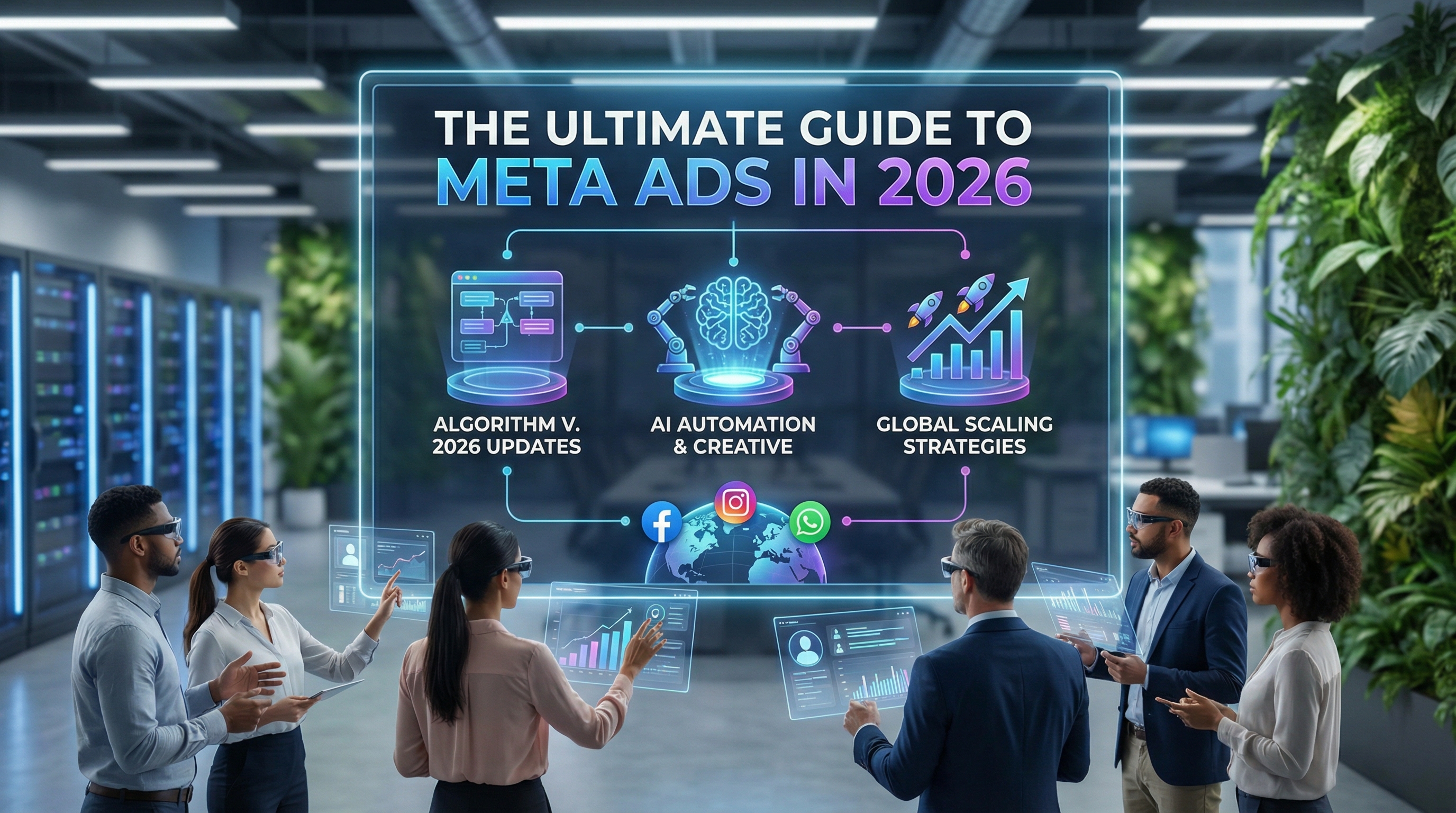
Meta has fully transitioned from a manual advertising platform to an AI-driven predictive ecosystem, powered by their engine often referred to as Andromeda. Meta retired several detailed targeting exclusions in favor of Advantage+ Campaigns, which strip away manual controls for algorithmic delivery. Instead of asking who you want to target, Meta's system now asks what you want to achieve.
The Three Pillars of Meta Ads in 2026
- Creative Signals — your ad creative is your new targeting.
- Unrestricted Liquidity — broad audiences and consolidated budgets give the algorithm freedom to find the cheapest conversions.
- Clean Data Integration — server-side tracking (Conversions API) feeds Meta accurate buyer data.
The GEM Algorithm & Why "Creative is the New Targeting"
Meta's AI architecture (Lattice, Andromeda, and the Generative Ads Recommendation Model — GEM) represents a paradigm shift. GEM is built on an LLM framework that "reads" your ad creative: objects in the background, tone of voice, text overlays, pacing, and emotional appeal — then uses these signals to find your ideal customer.
The "Sea of Sameness" Trap: because AI makes it easy to churn out near-identical ad variations, Andromeda bundles similar ads together and limits reach. The fix is Creative Diversity. A winning 2026 ad set mixes:
- The "Founder's Story" (trust builder)
- The "Chaotic Comparison" (logic appeal)
- "Native UGC" (social proof)
- The "Screenshot Proof" (curiosity hook)
Broad targeting is not a trend; it is a requirement. Restricting the algorithm with narrow interest targeting ties its hands behind its back.
Mastering Meta's 2026 Technical Arsenal
- The Conversions API (CAPI) — the non-negotiable server-to-server tracking standard, allowing you to send offline conversion data (e.g. a booked site visit) so the algorithm learns what a high-quality lead looks like.
- Advantage+ Takes Over — Advantage+ Shopping Campaigns (ASC) test up to 150 creative combinations simultaneously; detailed targeting exclusions have effectively been removed.
- Flexible Creative & DCO 3.0 — supply a "pool" of assets (up to 10 images/videos, 5 primary texts, 5 headlines, multiple CTAs) and Andromeda dynamically assembles the best combination per user and placement.
Structuring Advantage+ Campaigns for Maximum ROI
Meta's machine learning requires roughly 50 conversion events per ad set per week to exit the "learning phase." The cardinal rule of 2026 is Consolidation. The most profitable accounts use a "Hybrid Structure":
- The Advantage+ Scale Campaign (70% of budget) — broad targeting, 5–10 proven winning creatives, let the algorithm hunt for the cheapest conversions.
- The Creative Testing Sandbox (20% of budget) — a separate CBO campaign to test new concepts before "graduating" winners into the Scale Campaign.
- The High-Intent Retargeting Campaign (10% of budget) — a manual campaign targeting specific custom audiences to close the hottest leads.
A real-world example: for a commercial real estate developer, instead of separate ad sets by interest, launch one broad Advantage+ campaign and let distinct creative angles (ROI-focused video, architectural carousel, founder-led video) surface the right buyers.
Navigating the 2026 Attribution and Tracking Updates
- The Shrinking Attribution Window: Meta shrank its view-through attribution window to just 1 day (down from 7/28 days), making B2B and high-ticket lead gen numbers look artificially low in-platform.
- Event Match Quality (EMQ) is the New Gold Standard: your EMQ score (1–10) reflects how confidently Meta can link a website conversion to a user profile, based on hashed emails, phone numbers, IP addresses, and geographic data. Below a 6, campaigns get stuck relearning.
- The Shift to MER (Marketing Efficiency Ratio): total business revenue divided by total marketing spend across all channels — a better measure than in-platform ROAS given fragmented attribution.
Advanced Scaling Strategies for 2026
- The 20% Vertical Scaling Rule — increase daily budget by 15–20% every 48–72 hours to avoid shocking the algorithm.
- Horizontal Scaling via Creative Diversity — feed the testing sandbox radically different creative concepts to unlock new audience segments and avoid creative fatigue.
- Optimizing for MER, Not Just ROAS — if Meta-reported ROAS dips while overall business revenue and MER rise, the scaling strategy is working.
Conclusion: Stop Guessing and Start Growing
The 2026 Meta Ads ecosystem is unforgiving to those who cling to old habits. Success requires deep understanding of AI-driven delivery systems, advanced server-side tracking via CAPI, and a relentless focus on diverse, high-quality ad creative. Partnering with the best Meta ads expert is the highest-ROI decision you can make for your brand this year.
Want this playbook applied to your account? Get your free audit from Rubin George.